
Rooted in Relationship: Collaborative Soil Health Research
There’s something so inspiring about working alongside others on the land, our hands full of soil and our heads with ideas. Soil can really enliven us: the multifaceted, sustaining, living material that is so ripe with potential, teeming with life and symbioses. I grew up around farming, and you might say that arid land agriculture is in my blood. While involved in land-based work, I was drawn in to learn more about soil and the distinct relationship humans have with it. Through my master’s research, I wanted to support farmers who have stewarded the soil and carefully managed the land for future generations amid a changing climate. This goal led me to ask, what could I contribute to the field of soil science while collaborating with and serving farming communities?
Before graduate school, I worked at Tucson’s Mission Garden, a living agricultural heritage museum which tells the story of this region’s people, culture, and history through plants. It gave me the opportunity to learn about the first farmers of this region: tribal cultures that developed sophisticated agroecosystems which have enabled people to thrive here for generations. Our collective approach to the work sought to foster community through multigenerational knowledge-sharing and cooperative, diverse forms of engagement such as experiential learning. Everyone is welcomed to participate and learn through hands-in-the-earth work, research, and consultation with elder knowledge holders.
The distinct agricultural traditions of the border region are deeply connected at the core and identity of those who have called the Sonoran Desert home—for some, over millennia. Like the People, the food crops are amazingly resilient, adapted, and productive, and they made such an impression on me. Thankfully, I was able to learn and get to know them personally by growing them. I observed the way a Tohono O’odham ha:l squash plant could practically break into a run following a monsoon rain, or how Hopi corn simply grows best when planted in clumps of 6 plants, two paces away from their neighbors. Also, how years of erratic and unpredictable weather has made some traditional crops seem out of sync and less productive.
Over time, while growing heritage Sonoran acelgas greens, O’odham huñ corn, and ba:wĭ tepary beans, I started to wonder, how does the soil respond to these crops and Indigenous farming methods? Traditional methods do not use chemical fertilizers, plant by hand or with gentle, shallow plowing, reject herbicides and pesticides, have lower water demands than modern and foreign commercial counterparts, and importantly, the farmers hold a deep respect and relationship with the land. The research project developed as I consulted with tribal farmers and knowledge keepers, and slowly we formed research questions that could benefit growers and their communities.
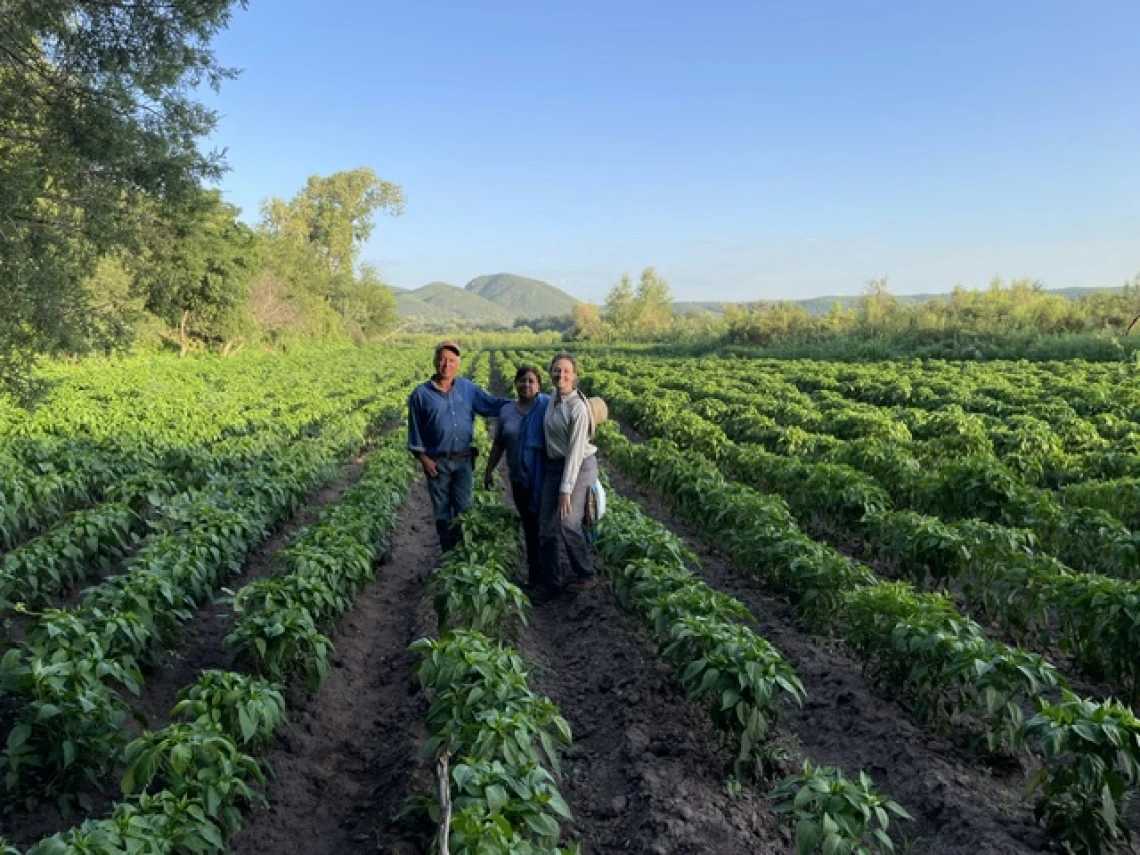
Alongside the farmers, I embarked on a research journey that aims to understand the benefits of traditional and Indigenous farming as compared to conventional methods. We will collect soil samples from traditional farms to analyze the chemical, biological, and physical characteristics in the laboratory, and compare the results to a set of soil samples from neighboring conventional farms. Seven tribal and traditional farmers* in Rio Sonora, Mexico, Tohono O’odham, White Mountain N’dee (Apache), Hopi, and Diné (Navajo) lands welcome the sampling to take place on their family farms. The traditional farmers with whom I’ve spoken know that the methods they learned from their parents, grandparents, and ancestors are beneficial to the soil (as well as to the seeds, and humans and non-human beings), though perhaps this has not yet been formally explored nor documented.
With the support of the Agnese Nelms Haury Foundation and the CLIMAS fellowship, we will conduct the soil health comparison study using community-engaged, transdisciplinary research methods. The farmers are invited to be co-researchers in the project, from shaping the design to analyzing the soil test results. Since farmers are concerned about who will be the next generation of farmers, we are inviting young people to participate in the soil sampling process, and we are orienting this research to offer learning opportunities for the whole community.
While this is a wonderful opportunity to engage with different tribes and perspectives, there is also a responsibility to remain accountable to them as well. We are committed to reporting back what we learn and abiding by Indigenous data governance principles. Due to the problematic history of harmful research conducted with Native Peoples in the US, I have learned about the methodical steps that we as researchers must take to work respectfully and ethically with tribes. Each tribe is different, but generally one must seek a letter of support from the partner farmer prior to approaching community leadership. A series of meetings and public presentations follow until a resolution is issued by the district council or farm board. Some tribes’ Institutional Review Board (IRB) or Cultural Preservation Office (CPO) require extensive review of several documents, in addition to the University of Arizona’s process.
From the beginning, I have been amazed and grateful for the communities’ reception, hospitality, and open-mindedness. The response to the proposal has been quite positive, and most feel that this research is important and beneficial for the community. I can recall one moment when I was nervously presenting to one tribe’s full district council to seek their permission. To my surprise, a representative from the Conservationist’s office appeared to deliver a formal statement in full support of the project, after having discussed it amongst the Soil and Water Conservation District board. I believe that when one approaches without assumptions or expectations and with a mutual interest in building long term relationships—in some ways like the farmer with their land—there is the possibility of a true alliance.

What I love about collaborating with farming communities is that amidst the hard work, you find yourself being woven into the community fabric: sharing meals, attending quinceañeras and funerals, wool processing workshops, weeding gardens together, or celebrating the roll out of the first irrigation lines to direct stored rainwater to field crops. Farmers welcome you to join special harvests such as bahidaj (saguaro), sharing with you about the methods and traditions. On long drives to visit rural farmers, my car is loaded up with abundant produce from Tucson’s winter citrus explosion to share back with community members who have to travel hundreds of miles to find local oranges.
I endeavor to live up to the expectations and meet the goals we’ve set together. Along this research journey, there will undoubtedly be new obstacles to navigate. I’m quick to remind anyone that I’m still a student learner, figuring things out by doing. While digging in the field with one of my Mexican partner farmers, I puzzled over a soil sampling detail, then I asked for his opinion. He replied to me, smiling, “Yo no se, ¡tu eres la scientista!” Surprised, I countered, “¡Pero tu eres el agricultor!” It reminded us that we both bring worthwhile perspectives, valuable voices, and valid experiences. By partnering together and collaborating, I hope we can recognize the work of tribal farmers and advance agricultural soil science alongside traditional knowledge for a stronger and more just food future together.
*Note: Farmer names have been withheld during the tribal Institutional Review Board (IRB) process.